Bank Street
If Beale Street Could TalkBank Street is both a precise point on the map and the intimate center of Fonny and Tish’s life together. In its basement, a modest workroom holds Fonny’s tools and sketches, their shared routines, and the prospect of a future; beyond it, the distance between Bank Street and Orchard Street becomes evidence in the dispute over Fonny’s arrest.
Setting and Interior
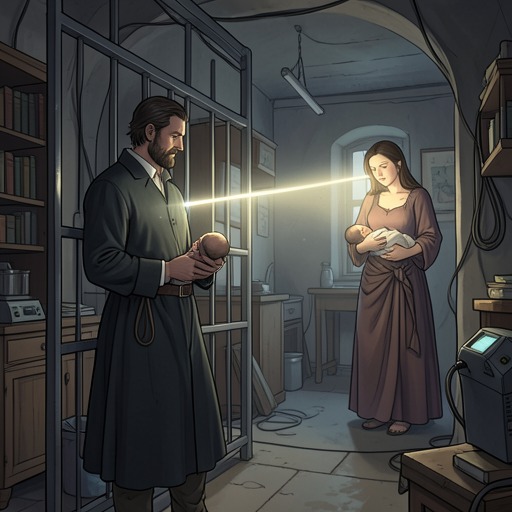
Tish first approaches Fonny’s pad through a quiet, dark street near the river, with no one else walking there. The route ends at a low black railing with spikes. Fonny opens the gate quietly, leads her down four steps, turns left, and unlocks a door beneath a weak yellow light. After a narrow, dark hall, another door opens onto the room. The descent makes the pad feel separate from the street above: a private space reached through a gate, steps, and successive doors.
The basement room is small and low, with windows facing the gate. It has a fireplace, a tiny kitchenette, and a bathroom with a shower but no bathtub. Its furnishings are sparse but specific: a wooden stool, a couple of hassocks, a large wooden table, and a smaller one. Empty beer cans sit on the smaller table; tools occupy the larger one. Raw wood and the smell of wood make the room an active workshop rather than a finished domestic interior. A mattress lies in the far corner beneath a Mexican shawl, while Fonny’s pencil sketches and a photograph of Frank hang on the wall. Work, rest, and family memory share the same confined space.
A Workshop Becoming a Home
The room’s objects register both Fonny’s work and the couple’s developing domestic life. The tools and raw wood connect the place to his craft; the mattress and shawl make it a place for closeness and rest. The room does not begin as a fully furnished home. Instead, its few belongings gather meaning through use, making the basement a setting where artistic labor and private life overlap.
One night, Fonny lifts the Mexican shawl from the pallet and drapes it over Tish’s head and shoulders. He jokes about seeing a rose in Spanish Harlem and says he will get her a rose for her hair the following week. The moment changes in tone: the joking stops, and the two remain still, looking at each other. Tish understands the feeling not as fear or yet as joy, but as wonder. Fonny tells her they are grown up now, and she nods. In the room that has held the practical details of their life, the shawl briefly becomes part of a shared recognition that their relationship has entered a new stage.
The sense of a future attached to the room is made explicit when Tish reflects that they will spend a long time there, that their lives will unfold in it. The basement’s small scale contrasts with that expansive expectation. It is not simply Fonny’s place to work: it is where the couple anticipate a life together and where Tish experiences Fonny’s presence as a source of comfort. The room’s significance comes from this combination of ordinary objects and shared expectation, rather than from any material abundance.
Reunion and Everyday Life
Bank Street also receives Daniel when Fonny encounters his old friend again. Fonny is so delighted that he brings Daniel to the pad, despite the expense of taking a cab. Tish recognizes Daniel from the light in Fonny’s face, while also noticing how much he has been beaten by his past. She leaves to shop so the two men can be alone. As she goes, Fonny puts on a record and Daniel sits on the floor drinking beer. The small domestic details—music, beer, food to be prepared, and Tish’s decision to give the friends privacy—show the room functioning as a place where friendship can be welcomed as part of the couple’s home.
The basement is also a setting for care between Tish and Fonny. In a later scene there, she is exhausted and turns toward him as she does when they share a bed. He holds her, and she whispers his name while listening to the household sounds from the kitchen. The room’s familiarity offers support without removing the strain surrounding them. Its private closeness exists alongside the demands placed on Tish and the uncertainty of Fonny’s situation.
Geography and the Case Against Fonny
Bank Street’s location acquires a sharper public meaning when Tish compares it with Orchard Street, where Victoria Rogers said the assault occurred. Orchard Street is near the East River, while Bank Street is practically on the Hudson: the two addresses lie far apart. Tish argues that it is not possible to run from Orchard Street to Bank Street, particularly with the police pursuing someone. Yet Bell swears that he saw Fonny run from the scene, and Fonny is arrested at the house on Bank Street. The distance makes the account difficult to reconcile with the geography Tish knows.
That contradiction does not, in itself, resolve the case. Tish stresses that the accused must prove and pay to prove the irregularity and improbability of the sequence. Bank Street therefore has a double role: it is the couple’s intimate home and workshop, but also the address around which the prosecution’s account can be questioned. The place that holds their anticipated life together becomes entangled with the legal effort to take Fonny away from it.